

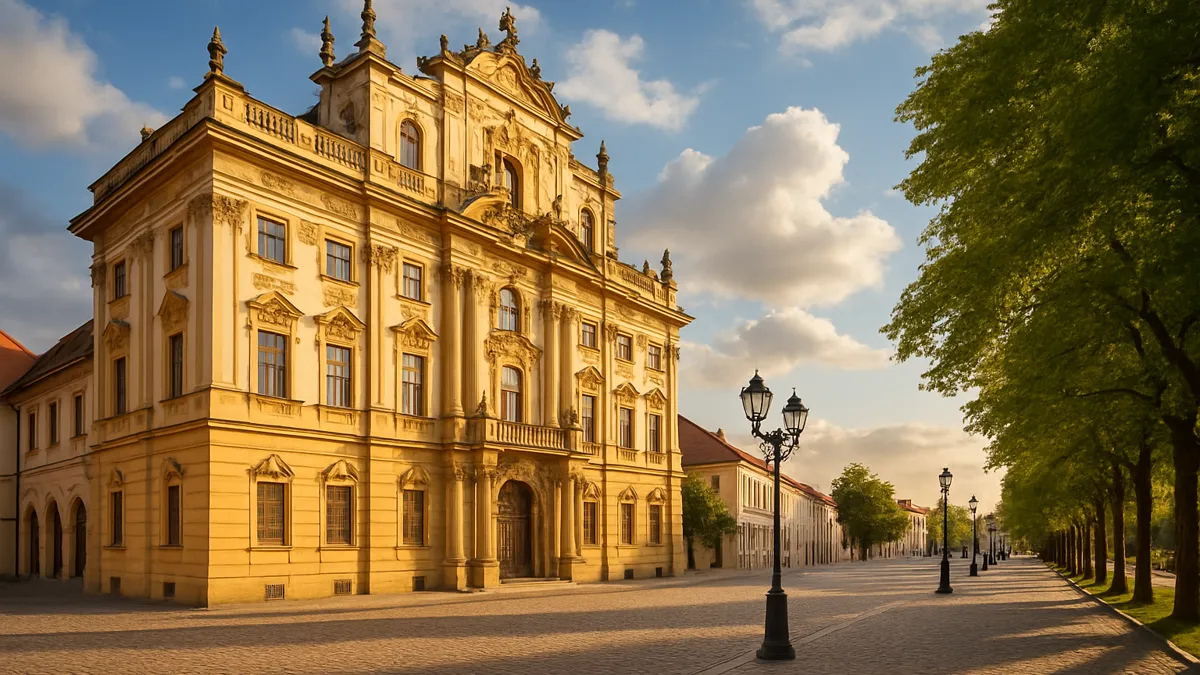
Few figures in European history combine military brilliance, political intrigue, and artistic patronage quite as dramatically as Albrecht Václav Eusebius von Wallenstein (1583–1634). Born into a minor Bohemian noble family, he rose through the chaos of the Thirty Years' War to become the most powerful military commander in the Holy Roman Empire — and for a time, the effective ruler of a vast personal domain in northeastern Bohemia, with Jičín at its heart.
From Market Town to Ducal Capital
When Wallenstein acquired the Jičín estate in 1621, following the forced sale of properties from Protestant nobles after the Battle of White Mountain, the town was a modest market settlement with a modest Renaissance character. Wallenstein had far grander ambitions. Between 1621 and his assassination in 1634, he invested enormous resources in transforming Jičín into a Baroque showpiece capital of his Duchy of Friedland (Vévodství Frýdlantské).
His vision was total: a new palace, redesigned squares, a Jesuit college, a loggia, and — most memorably — a grand ceremonial avenue lined with lime trees leading from the main square to the newly constructed Valdická Gate. He also planned a diocesan seat for Jičín, an ambition that the political circumstances of the war ultimately frustrated, though his architectural legacy endured.
Wallenstein's Palace
The Valdštejnský zámek (Wallenstein Palace) occupies the northern edge of Valdštejnské náměstí, the main square. Built between 1624 and 1634 to designs influenced by Italian Baroque masters, the palace is a four-wing structure arranged around a central courtyard. Today it houses the Jičín District Archive and is partially open to visitors. The Sala Terrena — a vaulted garden room decorated with Baroque frescoes — is among the finest surviving interiors of its period in Bohemia.
Valdštejnské Náměstí
The main square, named after Wallenstein himself, is one of the best-preserved Baroque squares in the Czech Republic. Its most striking feature is its extraordinary length — at nearly 240 metres, it is one of the longest historic squares in Bohemia. The facades that frame it range from Baroque to later Classicist periods, but the spatial composition Wallenstein ordained remains essentially intact.
At the centre of the square stands the Baroque Marian Column, erected in the mid-17th century as a votive monument, typical of Central European Baroque town planning. The column is surrounded by a low iron fence and flanked by the rhythmic arcades of the adjacent buildings.
Valdická Gate: Symbol of the Town
No image of Jičín is complete without the Valdická brána (Valdice Gate), the 52-metre tower that closes the eastern end of the main square's ceremonial axis. Built in the 1630s, its octagonal upper section and distinctive Baroque roof silhouette make it one of the most recognisable landmarks in northeastern Bohemia.
Visitors can climb the gate tower for panoramic views over the town's rooftops and, on clear days, toward the sandstone formations of Bohemian Paradise. The tower houses a small historical exhibition and is typically open from spring through autumn.
The tower is open April–October. Admission is modest. The climb involves narrow spiral stairs — comfortable footwear is recommended. The view from the top across the linden avenue is particularly beautiful in late May when the trees are in bloom.
The Linden Tree Avenue
Stretching from Valdická Gate toward the former Carthusian monastery at Valdice (about 2 km), the Libosad avenue of linden trees is a living monument to Wallenstein's ambitions. Originally planted in the 1630s as part of a pleasure garden and processional route, the avenue today is a protected natural monument. Walking or cycling its length in early summer, when the lindens are in blossom and scent the air, is one of Jičín's most memorable experiences.
The Jesuit College
Wallenstein invited the Jesuit order to Jičín as part of his Counter-Reformation building programme. The Jesuit College (Jezuitská kolej), adjacent to the Church of St. Ignatius of Loyola, was completed after his death but according to his intentions. The church itself, with its restrained Baroque façade, remains in use and can be visited during services and open days.
Wallenstein's End and His Lasting Imprint
Wallenstein was assassinated at Cheb (Eger) in February 1634, a victim of imperial conspiracy. His death ended the Duchy of Friedland project, but the buildings he commissioned at Jičín survived the subsequent centuries — wars, Habsburg administration, and the upheavals of the 20th century — largely intact. His story has fascinated historians and artists ever since; Friedrich Schiller immortalised him in his dramatic trilogy Wallenstein (1798–1799).
For visitors to Jičín today, the Baroque streetscapes, the monumental square, the palace, and the linden avenue are the most tangible evidence of one of early modern Europe's most extraordinary ambitions — a warlord's dream of a model Baroque capital, frozen in time in the heart of Bohemia.
Key Wallenstein Sites at a Glance
| Site | Location | Visitor Access |
|---|---|---|
| Valdická Gate | Valdštejnské náměstí (east end) | Apr–Oct, small fee |
| Wallenstein Palace | North side of main square | Partial; Sala Terrena by appointment |
| Marian Column | Centre of main square | Free, always accessible |
| Libosad Linden Avenue | From Valdická Gate to Valdice | Free, year-round |
| Church of St. Ignatius | Near Jesuit College | Open during services |