

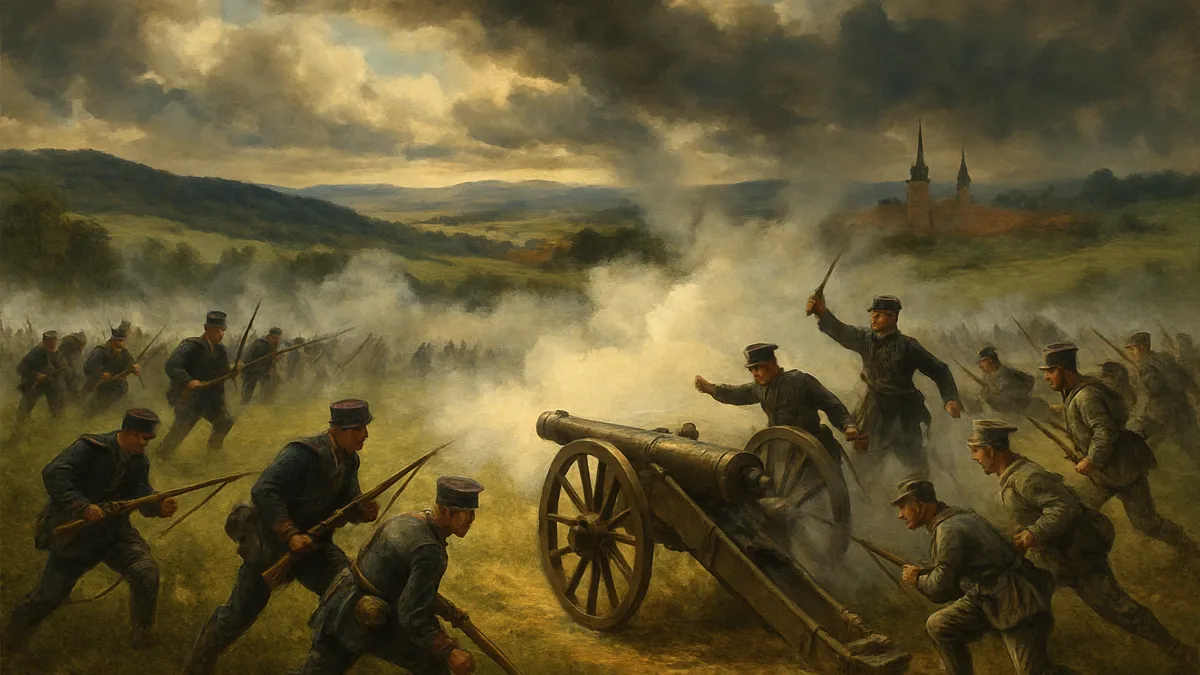
In the summer of 1866, the Kingdom of Bohemia became the principal theatre of a short but decisive conflict between the Austrian Empire and the Kingdom of Prussia. Among the engagements of this so-called Seven Weeks' War, the Battle of Jičín on 29 June 1866 stands out as one of the largest and most consequential fought on Bohemian soil — a clash that consumed nearly an entire day, cost thousands of casualties on both sides, and opened the road to the decisive Battle of Königgrätz just days later.
Background: The Road to War
The conflict of 1866 had its roots in a decades-long rivalry between Austria and Prussia for dominance over the German-speaking states. Prussia, under the ambitious statesmanship of Otto von Bismarck and the military genius of Field Marshal Helmuth von Moltke the Elder, had spent years modernising its army. The Prussian needle-gun — a breech-loading rifle capable of firing far faster than the Austrian muzzle-loaders — gave Prussian infantry a decisive tactical advantage that would prove devastating throughout the campaign.
When war was declared in June 1866, three Prussian armies crossed into Bohemia from different directions with the aim of converging on the Austrian Northern Army. The Austrian forces, commanded by Field Marshal Ludwig von Benedek, were attempting to concentrate near Königgrätz (today Hradec Králové) and fought a series of rearguard actions to delay the Prussian advance.
The Opposing Forces at Jičín
The fighting around Jičín on 29 June involved the Austrian 1st Corps under the command of Count Eduard von Clam-Gallas and the Saxon Army Corps, together facing the Prussian 1st Army. The Austrians and their Saxon allies occupied strong defensive positions on the hills and ridges west and south of the town, hoping to delay the Prussian advance long enough for Benedek's main army to consolidate.
Approximately 25,000–30,000 Austrian and Saxon troops faced a Prussian force of comparable strength. The terrain — a patchwork of gentle hills, woodlands, and the villages of Brada, Popovice, Robousy, and Zelenecká Lhota — offered both sides opportunities for cover and flanking manoeuvres.
The Fighting: Village by Village
The battle began in the late morning and rapidly evolved into a series of brutal village-to-village struggles. The Prussians advanced methodically, making effective use of their superior firepower. Austrian and Saxon troops counter-attacked repeatedly with considerable courage, but each time the Prussian needle-gun fire inflicted horrific losses on the attacking infantry.
By mid-afternoon, the Austrians had been pushed back through the villages toward Jičín itself. The town changed hands amid street fighting, and by evening the Austrians and Saxons were in full retreat northward toward Miletín. The rearguard actions were costly — Austrian losses amounted to over 5,000 men killed, wounded, or captured, while Prussian casualties were significantly lighter.
Strategic Consequences
The defeat at Jičín left the road to Königgrätz open. Just four days later, on 3 July 1866, the Battle of Königgrätz — the largest European land battle since Leipzig in 1813 — ended in a catastrophic Austrian defeat. Within weeks, the war was over and Austria was excluded from German affairs permanently, setting in motion the creation of the German Empire under Prussian leadership in 1871.
"The battle of Jičín was not merely a local reverse — it was the hinge on which the fate of Austria's position in Central Europe turned."
Visiting the Battlefield Today
The battlefield landscape around Jičín has changed remarkably little since 1866. The gently rolling countryside, now a quiet agricultural region, preserves much of the terrain the soldiers crossed. Several sites are worth visiting:
- Brada Ridge: The high ground where Austrian forces held their initial positions; accessible via footpaths from the village of Brada-Rybníček.
- Robousy village: Scene of some of the heaviest fighting; a commemorative plaque marks the site.
- Jičín Military History Museum: Houses an extensive collection of artefacts, uniforms, weapons, and maps relating to the 1866 campaign.
- Valdštejnské náměstí memorial: The main square contains monuments referencing the 1866 campaign and the broader history of the town.
The 1866 Trail
Local historians and the Jičín municipality have developed a marked walking and cycling route — the 1866 Trail — that connects the key sites of the battle across roughly 18 kilometres of Bohemian countryside. The trail is well-signed and includes information boards at each significant location, making it an excellent half-day excursion for visitors with an interest in military history.
The Jičín Museum (Muzeum Jičín) on Šafaříkova street is open Tuesday–Sunday. The 1866 battlefield trail can be started from the town centre. Free entry to the outdoor trail; museum admission applies for the indoor exhibition.
A Living Memory
Every few years, Jičín hosts commemorative re-enactment events on the anniversary of the battle, drawing living history groups from across the Czech Republic, Germany, and Austria. These events — combining historical demonstrations, period music, and guided battlefield walks — offer a vivid, accessible way to understand one of Bohemia's most dramatic historical moments. Check the Jičín town website for upcoming anniversary events.